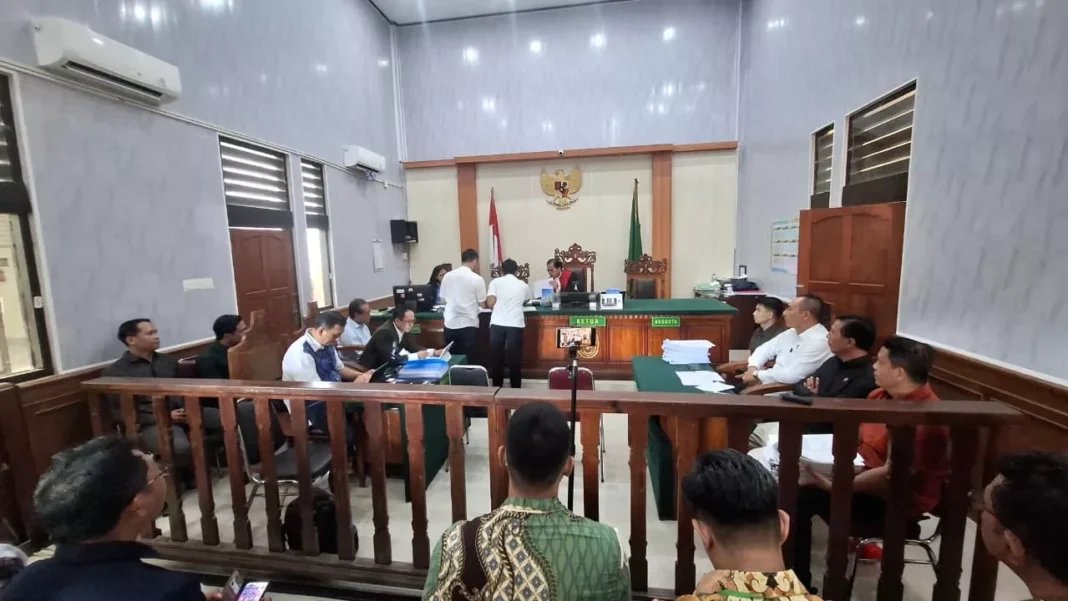



DENPASAR, Bali — A closely watched pretrial hearing involving Bali’s top land official has entered its decisive phase, raising broader questions about legal certainty and the application of Indonesia’s newly enacted Criminal Code.
The pretrial motion was filed by I Made Daging, Head of the Bali Regional Office of the National Land Agency (BPN), against the Bali Police. The case, registered as No. 1/Pid.Pra/2026/PN.Dps, reached the conclusion stage on Friday (February 6, 2026) at the Denpasar District Court, following the completion of witness examination and evidentiary hearings.
The session was presided over by a single judge, I Ketut Somanasa, and was open to the public. While formally a procedural dispute, the case has drawn national attention because it touches on how Indonesia’s law enforcement institutions are navigating the transition to the country’s new Criminal Code.
Lawyers Challenge Use of an “Expired” Criminal Provision
During the hearing, lawyers representing Made Daging argued that the designation of their client as a criminal suspect was legally flawed. According to the defense team, investigators relied on Article 421 of the old Criminal Code, a provision they claim no longer has legal force.
The defense maintains that Law No. 1 of 2023 on the Criminal Code, promulgated on January 2, 2023, effectively nullified criminal provisions from the old code that were not carried over into the new one. Article 421, they argue, is among those provisions.
“The three-year transition period concerns technical implementation, not the legal existence of criminal norms,” the legal team told the court. “Once the law was promulgated, it became legally valid and binding for everyone, including law enforcement.”
They further cited provisions of the new Criminal Code, internal guidance issued by Indonesia’s National Police Criminal Investigation Department, and a Supreme Court Circular (SEMA No. 1 of 2026), which they say instruct investigators to halt cases based on criminal articles that are no longer applicable.
In their view, continuing the investigation despite the absence of a valid criminal provision amounts to an abuse of authority. “No matter how extensive the evidence, it is meaningless if the criminal article itself no longer exists,” the lawyers argued.
Land Mafia Narrative and Missing Records
The defense also briefly addressed Indonesia’s long-running campaign against so-called land mafias, referencing public statements by Nusron Wahid, who has described land crimes as complex and involving multiple actors.
However, they claimed that the land object at the center of this case had already been reviewed by a Land Mafia Prevention Task Force in 2018, involving both police and land agency officials. The existence and whereabouts of that earlier assessment, they argued, now raise questions of record-keeping and institutional continuity.
With both sides having submitted their final arguments, the court is expected to issue a ruling in the coming days.
Why This Case Matters Beyond the Courtroom
For international observers, expatriates, and long-term residents in Bali, the significance of this case extends well beyond the fate of a single official.
Indonesia is currently in a rare legal transition, shifting from a colonial-era Criminal Code to a nationally drafted one. At the heart of this transition lies a fundamental principle of the rule of law: legal certainty. Criminal liability, under universally recognized legal standards, must be grounded in a clear and valid legal provision.
If criminal investigations continue to rely on articles that have been formally abandoned by new legislation, the transition risks creating legal ambiguity — precisely the condition the new Criminal Code was meant to eliminate.
For Bali, a province that attracts global investment, foreign residents, and long-stay visitors, such questions are not abstract. Confidence in governance, land administration, and law enforcement directly affects perceptions of stability and fairness — key considerations for anyone choosing to live, invest, or do business on the island.
A Quiet Test of Indonesia’s Rule of Law
The pretrial case now before the Denpasar court has become, in effect, a quiet test of how seriously Indonesia’s institutions treat their own legal reforms. The issue is not whether land crimes should be prosecuted — they should — but whether prosecutions are conducted within the strict boundaries of valid law.
As Indonesia moves deeper into the era of its new Criminal Code, courts are increasingly called upon to draw a firm line between legitimate enforcement and the residual habits of an older legal framework.
The upcoming ruling will signal whether Indonesia’s legal transition is being applied with discipline and consistency, or whether uncertainty still shadows the enforcement of criminal law. For Bali’s international community, it is a reminder that behind the island’s image as a global destination lies a legal system in the midst of significant change — and that how those changes are handled matters.